Entebbe

Entebbe focuses on the true story of the 1976 Israeli hostage rescue crisis. Which was about a terrorist organisation who hijacked a plane, with a large portion of Israelis on it and flew it to Entebbe in Uganda. Once there they tried to use the passengers as leverage to negotiate Israel into a prisoner release. Overall this is a very tense film, with the hostage scenes, in particular, reflecting this: due to you having a real fear for the passengers. This fear is helped greatly by terrific performances by Daniel Bruhl and Rosamund Pike. Bruhl brings a strong ambiguity to the character, as you see him begin to question If he is doing the right thing. However, the real standout here is Pike’s character of Brigitte Kuhlmann, who we see is incredibly unhinged, confirmed by a third act plot twist; and being the highlight of the film. Conversely, there are also significant issues with the character development. These issues are a lack of motivation for both Bose, (Daniel Bruhl) and Kuhlmann as we never see why they want to carry out this high jacking: beyond simply being angry at the status quo and “hating their country”. This issue is only intensified by the fact that Kuhlman is given flashbacks that seem to serve no purpose narratively. So, ultimately the characters are two dimensional. Furthermore, there are also significant pacing issues, best shown during a needless subplot focusing on a relationship between an Israeli Defence Force member and a dancer; which feels overly long. The modern dance scenes, which are a result of this plotline, feel tacked on for the sake of it. Making you wonder if they were included by the director Jose Padilha to make the film seem artsy, but instead missed the mark and are pretentious. The third act action scene is quite oddly bloodless, with the use of slow motion and, cuts to modern dance, not really letting you see much of what is going on. However, the accompanying non-diegetic piece of music does help to add to the tension.
Finally, the performance by Nonso Anozie as Idi Amin is in quite a contrast to the rest of the cast. Though Anozie plays Amin as serious there are moments of levity throughout his performance, which made people in my screening laugh, this is quite jarring. Overall there are highlights such as the score, as well as strong performances from Bruhl and Pike that help to elevate their stinted characters, but this simply isn’t enough as the pacing issues and, bloodless violence really do hurt the film.
3/5
Reviewed by Luke

The Strangers: Prey at Night

The Strangers: Prey at Night is a slasher film focusing on a family as they are terrorised by 3 masked killers. Now before we begin I just want to say that I love the slasher films of the 1980’s. Prey at Night is not new or original, it is the same thing you’ve seen before, however, the unoriginality isn’t a bad thing here. What I mean by that is, though every cliché in the slasher genre is used here, Prey at Night is happy to point out the cliches and have a laugh at them. This film in many ways is a very loving homage to 80’s slasher films, with everything from the near unstoppable killers to the rebellious teenager, proving that this film is very aware of its DNA. To phrase my overall thoughts in a succinct way this is “horror junk food” it is dumb scary fun to be enjoyed until better, more inventive horror films, like Hereditary, arrive. I think in many ways this film is better for being a sequel, as the scope is far larger, yes, it is still confined to one family but, at the same time, the new setting, of a trailer park, allows for far more grizzly potential than the house setting of the first film. The overall mythology of the Strangers themselves is kept maddingly vague; beyond the “Why not” mantra. The 3 Strangers are all suitable menacing, with Doll Face and The Man in the Mask being particularly threatening. The weak point of the film comes from the family Cindy, Mike, Kinsey and Luke, (Christina Hendricks, Martin Henderson, Bailee Madison and Lewis Pullman, respectively) being so bland. Hendricks who is the films big star is barely in it, with Henderson and Pullman being so bland and generic that you forget who they are after a while. However, the saving grace comes from Bailee Madison. Madison’s Kinsey is the only real, compelling character who is given motivations and is somewhat developed; and, I would be very interested to see a third Strangers film focusing on her. My final two notes about the film are one: the score is fantastic, with the 80’s song choices helping to give this film some identity and cement it as a homage to the Craven era slasher. With the other being that the ending is left open enough to set up a third film, depending on how well this one does, and that is a prospect I quite welcome. Overall there is some genuinely good scares here and a strong amount of tension, defiantly a step up from the first film but, it’s still only slightly above average.

2/5

Reviewed by Luke.

Walk Like A Panther

Walk Like a Panther is a British comedy film about a group of 1980’s wrestlers forced to don the tights one more time, to save their pub. This film actually grew on me the more I thought about it after I left the cinema. At it’s best this film is an underdog story which manages to capture the plucky spirit of something like Eddie the Eagle and, it’s in this that the film really shines. The film’s characters whilst likeable enough are mostly underdeveloped each representing a different stereotype. These characters aren’t fresh with most being a rethread of something you’ve seen better before. However, all that being said the characters are still incredibly likeable and, you root for them to win throughout the entire film with none of them being grating or annoying. The jokes most of the time don’t work or at least didn’t for me, to a point where sometimes they are cringingly bad.
However, scattered throughout the film there are occasional jokes that do work quite well and, I found myself laughing hard at most of these. The film is quite well paced which is a nice contrast to a lot of recent releases and, doesn’t suffer from any needless bloat. The editing was quite good in this film with an excellent montage sequence and, a slow-motion scene that lovingly lampoons the sports genre. Although, the choice of song during the montage sequence being Gold by Spandau I found to be quite jarring and took me out of the film. In terms of performance, a lot of the characters are quite forgettable, with the real meat coming from the father-son story of Mark and Trevor. Mark played by Stephen Graham is the most well written and flushed out character here and, Graham performance is excellent. Mark’s character motivations which are to one day following in his father’s footsteps and be a wrestler just like him always felt very genuine. The relationship between Trevor “Bulldog” Bolton and, his son Mark is perhaps the soul of the film and, personally, I found it quite relatable. Furthermore, Michael Socha’s character of Ricky is the highlight of this film every scene he is in is outstandingly funny and, he really brings something to the film. The cameo by Game of Throne’s own Lena Headey is amazingly random and, she really does bring an air of class to the proceedings. This is not the best comedy film of the year it is fundamentally flawed in a lot of different ways. In spite of that the main character and, the underdog story that is at the heart of it all really does make this film quite touching. I would recommend this even though it isn’t the best film.

3/5
Reviewed by Luke.

I,Tonya

I, Tonya tells the true story of Tonya Harding, in a faux documentary manner. This is a very entertaining biopic and has plenty of laughs throughout its runtime, but also has great emotional stakes. My most lavish praise has to go out to the costume design for this film. The costumes that Margot Robbie’s Harding wears are simply stunning. You can tell that a lot of thought has gone into the look and feel of the film because everything from the costumes to the hairstyles is so reminiscent of the early 90’s. This makes it very accurate and believable. This believability caries over into the storytelling, as the film tries to be as accurate to the events as possible. This is shown at the start of the film when they say they’re using multiple interviews to try and put together a timeline. Furthermore, the use of fourth wall breaking adds both a sense of intimacy, as well as helping to highlight certain facts. The performances are outstanding with Robbie, in particular, a standout. Robbie manages to convey what can only be described as the troubled life of Tonya Harding with such believability, that you lose yourself entirely in her performance. Robbie is the heart and soul of the film and is consistently likeable throughout. The film itself makes not rooting for Tonya damn near impossible, and this is due to Robbie’s performance showing you the person behind the media image. Also, Sebastian Stan’s performance as Jeff Gillooly is captivating and brilliant. The fits of anger that plague Jeff’s character, are so well acted by Stan that his presence on screen is both unpredictable and genuinely quite scary. The menacing delivery that Stan employs for some of his lines really does help to elevate Jeff’s threat level. Additionally, Allison Janney’s performance as LaVona Fay, (Harding’s mother), is outstandingly cold and malicious. With her character serving as a kind of antagonist throughout the film. Janney’s performance helps to raise LaVona from a simple two-dimensional abusive mother into something much more. As we see that LaVona thinks that what she is doing is right and actually helping her daughter, making her character in a way an interesting comment on parenting. The direction from Craig Gillespie is remarkable, with not a single scene or character wasted, and with the whole feature feeling like a cohesive whole rather than just a rush to later events. The score for this film may be my favourite so far this year, so accurately capturing small-town America at least in my opinion. The final thing I want to touch on is the choreography of the skating scenes, which is just fantastic, with the cinematography lending itself so beautifully, with each camera shot; having something to say.
An amazing film, and a baffling true story this is definitely worth a watch. A real powerhouse of a film, on every level.
4.5/5
Reviewed by Luke

The 15 17 to Paris

Spoilers ahead.

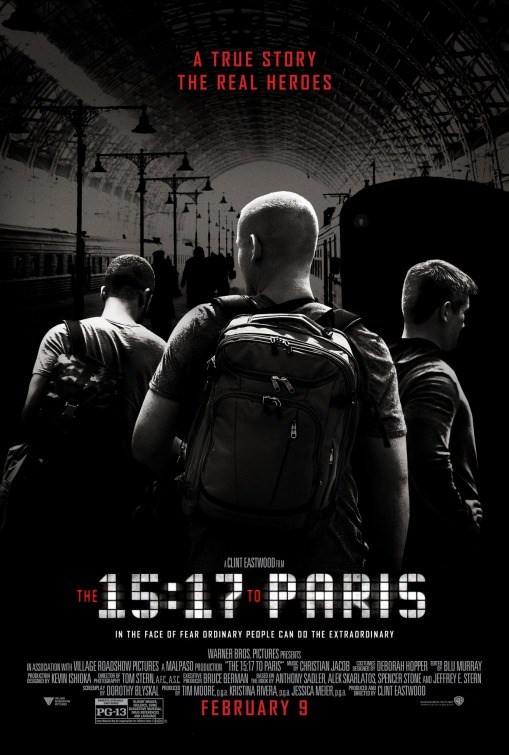
Firsts thing first, let just give Clint Eastwood some praise for the ballsy decision to cast the real-life soldiers in his film; rather than hiring actors. It was this factor that was always going to make or break the film, they might be heroic soldiers, but could they act? Surprisingly they can, with Anthony Sadler and Alek Skarlatos, being particularly good. However, that is where the positives end for this film. The first half an hour when the 3 men are children, is painfully hard to watch, with none of the child stars being at all likeable. Furthermore, there is some needless political and religious message shoved in for the what feels like the sake of it. This continues to be a problem throughout the film. The writing for this film often sets up a theme or plotline and then just moves on to the next one, never satisfyingly delivering on them, and all these subplots and anecdotal things just feel tacked on. What is the ultimate negative of this film, is the titular train is only about 15 minutes of the overall 1 hour, 30 minutes run time. Everything else that encompasses the other 1 hour and 15 minutes is glorified filler, that tries to establish the soldier’s lives and what motivates them but ultimately falls flat. In addition, it seems that Eastwood knows most of his film is filler as he foreshadows, (in almost a teasing way) the train journey throughout. This is shown when Spencer says “I feel like life is catapulting me towards something” about halfway through the runtime, they have a whole conversation about it, it’s the most blatant, badly used foreshadowing I’ve seen in quite some time. Another issue with the film is that a lot of the dialogue feels trite and unbelievable, this is again mainly presented in the section when they are children. The lines that particularly brought me out of it, were when the children were introducing each other by their last names, as well as an emotional scene where a young Spencer and Alek are saluting each other that just feels wrong and out of place. The film is really split into 3 parts when they are all children being the first, (which is damn near unwatchable, with Judy Greer performance as Joyce Eskel being it’s only saving grace). The other two were the trip around Europe that the 3 men were on, and then finally the train ride. Whilst the trip around Europe is well shot and to a degree enjoyable, it has an unmistakable feeling of filler and feels weirdly off base with what the rest of the film is about, and makes you question why Eastwood put it in. However, the final section when they’re on the train is where Eastwood shines, with it being an incredibly well shot, and having a very real, visceral, believable feel to it; that manages to capture the seriousness of the situation. It just as shame that this good sequence is only about 15 minutes of the film. Overall, I left questioning a lot of things, mainly whether this would have been better as a documentary rather than a feature film? Secondly why a lot of scenes has been included? Thirdly why the script rammed political and religious messages down your throat? If I had to point out the biggest issue the film has it would have to be the script, which was wildly, and I mean wildly all over the place, with some of the worst dialogue and foreshadowing, I’ve possibly seen in years. The only redeemable qualities the film has are, Judy Greer’s performance, the 3 soldiers were all convincing and performed well, and the final section of the film on the train is well-done and believable. To conclude I can’t suggest you go out and see this because it just has so many problems, and the only enjoyable part of the film is the last 15 minutes; that’s just a bad investment for your money.

1/5
Reviewed by Luke.

All the Money in the World

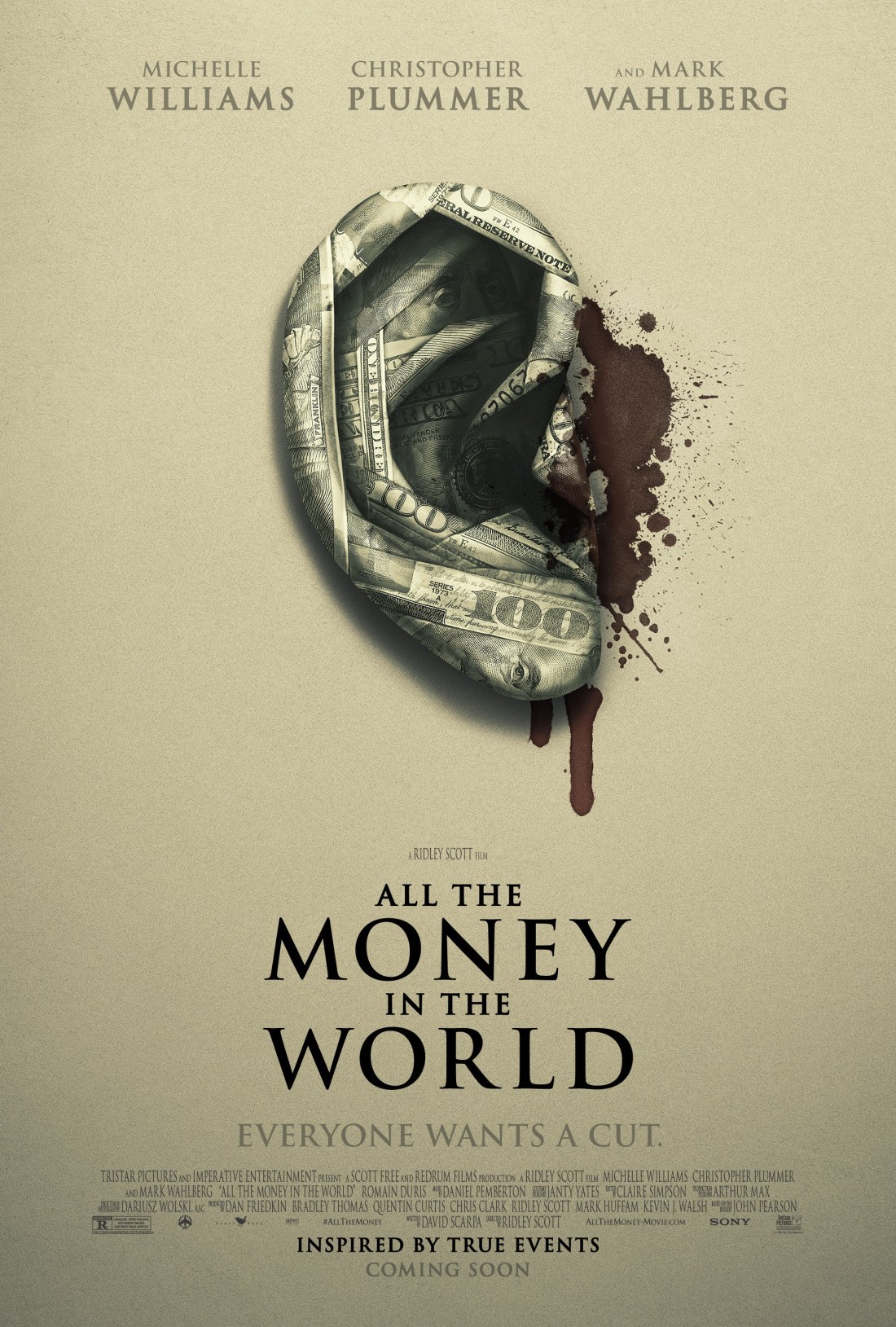
This film is a testament to Ridley Scott as a director, with him replacing an actor and reshooting all his scenes only months before release. Whats more these scenes are hard to tell apart from the rest of the feature, blending in well; in contrast to other recent releases such as Justice League. Christopher Plummer portrays the role with equal parts ruthlessness, and a sheer sense of greed that perfectly encapsulates the character of  J. Paul Getty. The film itself centers around the kidnapping of Getty’s grandson Paul, (played here by Charlie Plummer), and Getty’s refusal to pay any money in random. At its core, this film is defined by 3 key performances, Christopher Plummer’s Getty, who is tremendous throughout. With the performances of Michelle Williams, (Gail Harris), and Mark Wahlberg, (Fletcher Chase) also being critical. This is where the film fumbles, Michelle Willimas is perfect with her performance of a mother in crisis, trying to get her son back being both believable and the emotional backbone of the film. For anyone who has read any of my other reviews, they will know that so far this year I ‘ve been a big Michelle Willimas fan, with her role in the greatest showman being one of the best and most believable parts of that movie. However, it is the third key role that falls flat and that is Mark Wahlberg’s Chase Fletcher, who feels bland and uninteresting, really his role could be played by anyone. The strange standout social relationship of this film is between Charlie Plummers Paul and Romain Duris as Cinquanta, who are both excellent characters in their own right, but together they’re somewhat of an endearing pair. Duris’s Cinquanta is a sort of father figure to Paul and provides an interesting contrast to the usual stereotype of the despicable criminal. Through the character of Cinquanta, Scott explores the idea of a family with this man who is a criminal, who is one of the men who abducts Paul ultimately caring about him just as much as his mum. Furthermore, Cinquanta, when juxtaposed with Mr. Getty, is shown to be far more caring towards Paul than his own grandfather. This portrays one of the victims of the film as ultimately one of the antagonists.  The negatives for this film really come from pacing, the film is paced badly, with the second act feeling dull and ultimately unnecessary, with too much time spent looking at the Chase, Getty relationship which ultimately goes nowhere. There were points in this film where it lost my interest to such a point, I debated the merits of going to the toilet for a prolonged break. Also, there were subplots with characters such as Pauls father which again feel like they go nowhere, with his character going through big changes in the first act without much explanation.  The film could have benefited greatly from focusing more on Michelle Willimas’s character, and ditching Wahlberg outright. This is a gripping story sadly it’s just too long and not interesting enough, though I did appreciate the unusual captive captor relationship.

2/5

Reviewed by Luke

Molly’s Game

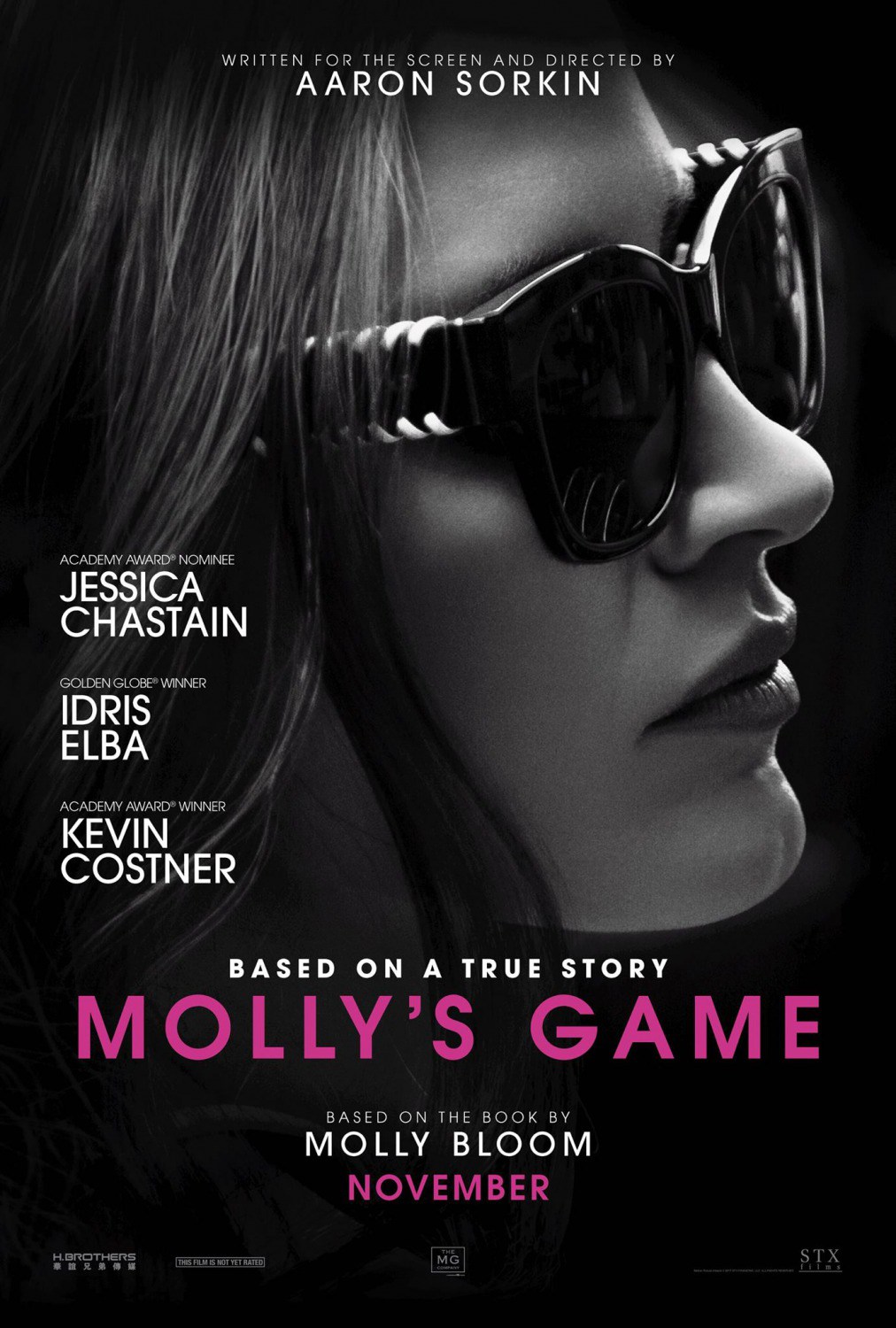
Molly’s Game tells the true story of “Poker Princess” Molly Bloom, for those of you who don’t know Molly Bloom was running million dollar poker games in both New York and LA. Now I’ve been looking forward to this film for quite a while, because it marks Aaron Sorkin’s directional debut. Sorkin has previously won an Oscar for his adapted screen play for the Social Network, fans of Sorkin’s previous work would expect his usual quick and snappy dialogue and that is here in abundance. The script and dialogue of Molly’s Game feels like a tour de force for Sorkin, serving as a highlights reel of everything that makes him one of the best currently working screen writers. Furthermore, the plot of the film itself has enough twists and turns to genuinely keep you on the edge of your seat, with all the characters being three dimensional and well formed.  This excellent formation is shown in Jessica Chastain’s Molly, who is shown as both powerful and savvy whilst also having moments of weakness. Jessica Chastain is on top form here and makes Molly a very easy to root for character, even when she does things that you don’t agree with. The best pairing in this film is easily Chastain’s Molly and Idris Elba’s Charlie Jaffey, the scenes that feature the pairs back and forth are  easily some of the most enjoyable moments in the film, and the two have an easy chemistry through the entire proceeding. Elba’s Charlie is somewhat of an audience surrogate as he goes through the same journey as the audience, believing in the beginning that Molly is guilty and he has no interest in her case, but as the film continues he starts to see her more and more for her she actually is and see’s past his first impressions. The friendship Jaffey and Bloom have at the end is testament to Sorkin’s writing ability as you can see the friendship blossom throughout the film, and doesn’t feel rushed but rather earned. Even Molly’s father played by Kevin Costner, who at first seems to be plying the disappointed father stereotype,  is later shown to be more than he seems, really it is foolish to assume anyone in a Sorkin film is as simple as they first appear. My only complaint about the film is that it is slightly too long at 140 minutes, with me personally thinking it could still be an excellent film at the 120 minute mark, but other than that this may be one of the best crime dramas I’ve watched in a long time.

4/5

Reviewed by Luke