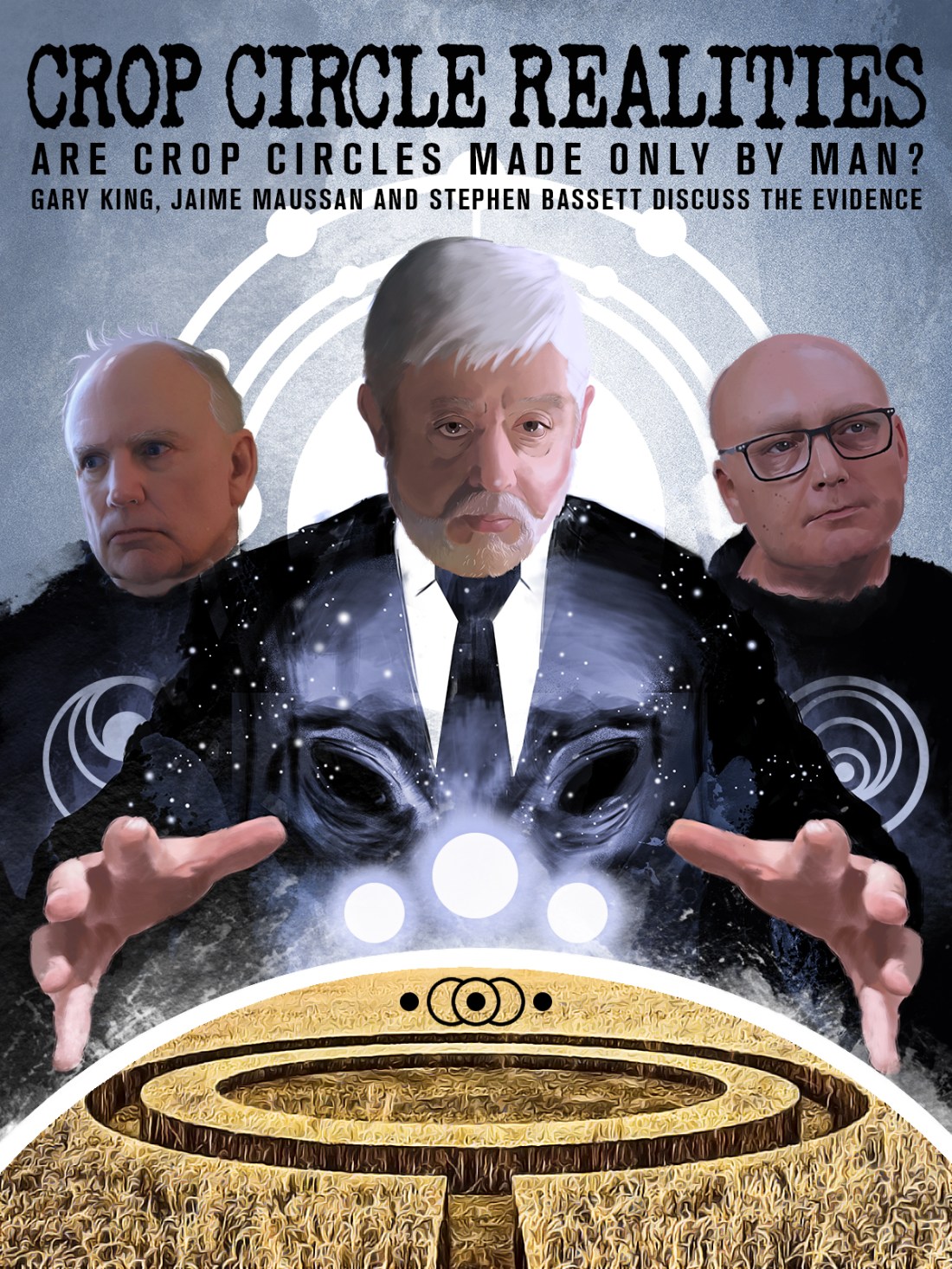
Crop Circle Realities: Lights In The Sky

Written by Luke Barnes

Crop Circle Realities is a documentary film directed by Darcy Weir. The plot of the film explores the phenomena of crop circles, and there possible alien connection. This documentary seeks out answers behind the creation of crop circles.

So, I must confess before watching this I had heard of crop circles before, in regard to aliens, but I never knew much about them beyond the basics. Luckily for me this film teaches you a lot about crop circles as a phenomena and is quite accessible in its presentation so everyone can understand and follow what is going on, regardless of prior knowledge.

I think the documentary strives to be informative over salacious, which is always a good thing, more so the film allows you to have fun watching it and feel entertained whether you believe in its central narrative or not.

Moreover, the more conservative run time of this film being only just over an hour allows it to operate at a nice quick pace: feeling like it is hitting on all the major points without feeling dragged out or padded for time, which can often cost documentaries marks.

Overall, a fun and informative documentary that raises some interesting questions and that prompts you to do you own research after the film ends.

Pros.

The pace

The accessibility

A lot of fun

Watchable even if you don’t believe in the central narrative

Cons.

A few ideas get brushed over and could do with a bit more time exploring them

3.5/5   

If you enjoyed this review, then please head to my Patreon to support me, I offer personalized shoutouts and the ability for you to tell me what to review next. Check it out!
https://www.patreon.com/AnotherMillennialReviewer

Beware The Slenderman: A Look Into The Dark Heart Of The Internet

Written by Luke Barnes

Beware The Slenderman is a documentary directed by Irene Taylor, centring around the internet creepypasta figure of Slenderman, and the real world nightmare that saw two young girls stab one of their classmates multiple times in an effort to appease the fictional being.

I remember when I was a teen and Slenderman was all the rage, it was a huge moment in internet folklore history. I think the idea of a shared communal myth is so fascinating, and that is really what Slenderman is, an idea added to over and over again and turned into something much bigger than it began as.

This documentary is very bleak, but you knew that coming in. Tragic is the word I would use to describe the events that this documentary highlights, it raises questions around how does the content we view affect us on a psychological level and, where is parental accountability when it comes to policing what your kid watches and doesn’t watch?

I think the documentary does quite a good job in explaining what Slenderman is, they also have folklore experts as talking heads to talk about the idea of building and creating myth which I think is a truly strong choice in this regard.

I think using the girl’s families as talking heads to explain the events that transpired is both a pro and a con, it is a con in that there will inevitably be a degree of bias there especially when it is parent child as it is here, however, it is also a pro as it allows us to have a uniquely personal view into the incident.

Overall, a strong documentary that raises a number of good points and provides a thorough and well thought out investigation into internet urban legends.

Pros.

The personal access to the case

A good explanation of Slenderman and the internet urban legend

A number of thought provoking questions are raised

A solid pace throughout

Cons.

Bias creeps in

4/5

Interview With Ross Munro: Writer/ Director For European Tour 73

Hey Everyone! I recently had a chance to interview Ross Munro, the writer director behind European Tour 73 a documentary film with animated elements about Monroe’s family holiday to Europe when he was a child. We discuss, travel, family and Fellini. I hope you enjoy.

Q: If you had to sum up European Tour 73 in a word what would it be?

A: Memories

Q: Who is your filmmaking inspiration?  

A: Fellini for his wild inventiveness and powerfully visual poetic sense combined with his dreamlike sensibilities and almost child-like sense of nostalgia. I grew up going to movies in the early 1970s so the New Hollywood filmmakers like Scorsese and Altman were also a big influence. More currently I’m excited by Tarantino and PT Anderson.

Q: What was your catalyst for making the film?

A: As both my mother and father have passed away, I felt compelled to make “ET’73” as a loving tribute to them and their memories and, in a way, to immortalize this crazy trip they took us all on back in 1973 as it seemed like a seminal event that really defined and brought us together as a family.

Q: If you could go back in time to when you were first starting out as a filmmaker what would be some advice you would give yourself?

 A: I would tell myself to break through the fear that I had about moving forward to make films and that it’s okay to make “mistakes” as they are actually learning experiences that in the long run will make you a better artist and person. Also, try and take a little time to absorb and enjoy the journey of making your films and don’t worry so much about the destination down the road. Also, always try to seek out like-minded, passionate collaborators.

Q: What made you decide to include animation in your film?

A: With “European Tour ’73” we knew from the beginning that we wanted to tell the story of our family’s trip to Europe using every visual element in the cinematic toolbox- along with the core of Super 8mm film that composed the heart of the film, we used stock footage, photos, live action footage that we shot and so animation was the next logical extension of how to tell our story. It was quite exciting to work with the animator on these segments and really added a new, exciting dimension to our film that viewers have repeatedly commented on favourably. I’m actually planning on doing more original animation for our next documentary as well.

Q: How did you decide on the balance between animation and stock footage within your film?  

A: The goal was always to just punctuate our film with the animated segments to add depth and humour and insight to the proceedings- of course once the film was completed I had more ideas that I would have loved to see in the film but, alas, that’s always the case when you look at a finished film: you always see the things you wish you’d included.

Q: What would you say the message of European Tour 73 is?

A: Oddly, I’ve never been asked that before. I’d say the message is to appreciate the time you are gifted on this planet to spend time with your family and loved ones. Even though the film is very joyful I can’t but help to feel also a small sliver of sadness that my parents and my eldest brother Jim- who passed while we worked on the film- never had a chance to see “European Tour ’73” as it’s a testament to my memories of them as much as anything.

Q: Within the family unit how important do you think shared experiences are?

A: I think you can’t overstate the importance of shared family experiences- especially growing up. My parents always strived to raise us in a manner where myself and my five siblings always did things together- the trip to Europe back in 1973 being the highlight of that philosophy. Because of their efforts to have us do things constantly as a family unit, I was able to move on through life having a great relationship with all my brothers and sister- almost like we are friends. This bedrock foundation is absolutely a direct result of my parents notion that we share as much time as possible as a family growing up.

Q: Would you one day take your kids (or potential kids if you don’t have any yet), on the same tour?

A: Not having kids (I guess my movies now represent my children- and how naughty they’ve been let me tell you…!), I’ve never had to contemplate this undertaking but one of the reasons I undertook this movie was also that I was amazed that my parents would actually bring all of us small kids barnstorming around Europe all tightly packed into a camper van for 6 weeks! Also, it seems crazy to me that I’ve never returned to Europe since that trip nearly 50 years ago! My wife, Maria, (who’s also the Producer of the movie as well as most of my past and future movies) and I really want to go to Europe someday soon and we look forward to screening our film in the many countries I visited in the film. This would, in a way, bring the whole journey of “European Tour ’73” full circle.

If you want to watch European Tour 73, it is currently playing on the virtual film festival circuit and will be playing in Canadian cinemas once the pandemic is under control, as always I have a review up on my site now!

Interview With Shaun Rose: The Star/ Co-Writer And Director Of Making And Unmaking

Written by Luke Barnes

Hey Everyone! I recently had the chance to have a chat with Shaun Rose, the writer/actor/director behind Making And Unmaking a very personal documentary film that chronicles Rose’s experiences within the film industry around the film of him making Upstate Story. We discuss the creative process, whether the toll of Hollywood is worth it, and mental health. I hope you enjoy.  

Q: If you were to sum up Making and Unmaking in a word what would it be?


A Therapeutic. Another word would be extensive or exhausting.

Q: What was your message with this film? To inform? To share?


A: Initially it was just me trying to get so many feelings out in the midst of production of ‘Upstate Story’ as they both overlapped. I was in a deep crisis period. I will say that many who have watched the film consider it educational in regard to the creative process. Not just the no budget tier of filmmaking. 

Q: What was the inspiration or catalyst for you making this film?


A: Just wanting to heal or get better. My mental and physical health were in pretty rough states due to so much I was going through. I wanted the film to act as a sort of journal or diary where I could vent. 

Q: Would you describe the struggle you and other filmmakers go through to get films made as worth it?


A: Most of the time. There are horror stories out there. Mainly in Hollywood where filmmakers have expressed regret over certain projects. For myself, I have no regrets at all. It might be hard and at times frustratingly difficult, but the finished product has always been worth the hardship. 

Q: What advice would you give to young filmmakers working in the industry right now?


A: Keep writing and filming. There are a plethora of affordable cam options out there for you. Even modern cell-phones are being used frequently. Go for whatever you want to do. 

Q How did you find the production of Making and Unmaking different from that of your other projects?


A: I’ve only experimented with the documentary form in college so that was a departure from the norm. Many years in between. I also just started using DSLR’s too for the documentary so that was a learning curve. I was late to that party.

Q: Did you find the format of Making and Unmaking, freeing or constrictive?


A: Very freeing, but at times overwhelming. As a documentary, I feel the possibilities are endless or more flexible. Just stick to the truth no matter what. It’s the editing that becomes hard. Trying to keep the story moving along all the while keeping a smooth edit going is where it gets tricky. We only had 1 cam to use during the interview sections, so we had to film each interview 2 times at different angles. From there, try to splice it together. Trying to place the music by Jake was also tricky. Considering it’s a documentary, it was especially tricky. I just took his tracks and placed them in a way to compliment as opposed to overwhelm. I hope I did him justice.

Q: If you won an award who would you thank?


A: My children. Adrianna and Keenan. My co-creators on the film. My Father, Andrea, Jake and Charles. My family, critics who gave my work a chance. A bunch of my friends who have been very close to me in my darkest times. People to confide in during both personal and creative rants. And those that have passed who made a strong impact on me as a person. Gracelynn, Sue and Darlene. 

Q: What are your closing thoughts on the film industry in general?


A: I’m concerned about where it seems that comedy is headed. For centuries, comedy has largely consisted of others laughing at the misfortune of others. It’s always been offensive to some degree or other. There are so many different realms of comedy as well and nowadays, I fear that we’re heading into territory that minimizes what we can laugh at. Perhaps I should say censorship in general. 

Q: If you could go back in time to when you were young and just starting out in the film industry, would you tell yourself to go for it, or to rethink?


A: Go for it. It’s difficult, but getting your works out there, seen and appreciated, makes all the struggle worth it. 

You can check out Making and Unmaking right now on Youtube, and as always you can find a review of the film on my site!

Making And Unmaking: A Frank Conversation With A Filmmaker

Written by Luke Barnes

Making and Unmaking is a candid documentary short film directed by Shaun Rose. The film sees Rose open up and discuss various triumphs and sets backs he had whilst making his feature film Upstate Story.

If you have an interest in the production side of film, then I would say this is a must watch.

Those of us who have made a film before, are presented with an earnest and frank conversation that we all know well, making a film is one of the hardest things a person can do. As Rose details the events surrounding the production of the film, he paints us a vivid picture of the place his life was in, his fight to get this film made. Touching is not enough to describe this film, but as someone who has made short films before (and would dread the pressure of making anything longer), I can say that this film is incredibly relatable.

Moreover, if you have never made a film before this is still immensely enriching, as it provides a very honest look into the sort of things that filmmakers go through, and what life is really like on a film set.

Overall, this is a very special film in a lot of ways, and it brought a tear to my eye. A beautiful story that needs to be heard.

Pros.

The honesty

The raw emotional weight

A useful educational tool

Very relatable

Cons.

Those not into film production may find less to be interested in here

4.5/5

Fyre: People Have Too Much Money

Reviewed by Luke Barnes

Fyre is a documentary film directed by Chris Smith. Of the two Fyre Festival documentaries out there this is the Netflix one, which seems to be the more well praised of the two. The documentary tells the story of the infamous Fyre Festival, a musical festival on a private island that ended up tricking influencers and other minor celebrities out of millions. The film analyses the days leading up to the inevitable disasters and tries to explain who was responsible.

My, my, the things people spend money on. Some people can afford 800,000 wrist bands for exclusive private festivals while others have to choose between heat and food, what a world.

So, this is a fun documentary to watch, yes it would be sad for the people who fell pray to the scam, but to those watching at home it is a nice trashy documentary to sink our teeth into. Much like junk food we know this has no artists value, but we consume it to take a little bit of joy out of watching these entitled influencer arseholes get dicked over, no? Just me?

I appreciated that the film had talking head guests who were actually there and involved, it allowed it to feel believable and trust worthy and though they might have some bias at least they have first hand knowledge and aren’t ‘web sleuths’. I also appreciated that though there have been developments since, this film tried to package everything together into one ultimate Fyre Festival narrative.

Overall, a nice bit of documentary junk food.

Pros.

A fun watch

Sustaining junk food

Interesting and somewhat reliable talking heads

A complete story, for the most part

Cons.

It has no artistic value

4/5  

Framing Britney Spears: Justin Timberlake Is A Bad Dude

Framing Britney Spears is a documentary film directed by Samantha Stark. The film explores the ideas around the #freeBritneyMovement and the fact that despite being only 39, Britney Spears has been under a conservatorship since 2008, with her father managing her estate and finances: this film aims to understand why that is.

This will make you angry, there is no other response you can have. It highlights flaws within the American legal system that are rife for abuse, it shows how the public’s obsession with celebrities can lead to destroying said celebrities life, and finally it show us just how sleazy Justin Timberlake is; in case you didn’t already know.

I think in terms of professionalism this is a solid documentary, as they speak to knowledgeable people on the matter and stick to the facts. Unlike other recent documentaries such as Netflix’s one about Elisa Lam, this documentary only gives a limited amount of time to online sleuths and activists, which makes for a more believable watch as you are not being bombarded with conspiracy theories.

I think the documentary is very needed, it deals with issues surrounding how women are treated in our society and the additional spot lights they are placed under, it is a very saddening watch especially when considering the impacts of self-reflection on how we the viewer see celebrities, though it does end with a message of hope, which personally I needed.

Overall, a well-done documentary.

Pros

Limiting the amount of online sleuths featured in the documentary

Using knowledgeable sources that had close ties to Spears

Causing inward reflection on celebrity

Pointing out holes in the legal system

Cons.

It is too short.

4/5

Reviewed by Luke

A Glitch In The Matrix: You Will Never See The Matrix The Same Way Again

A Glitch In The Matrix is a documentary film directed by Rodney Ascher. The film servers to analysis the simulation debate, looking at first hand accounts as well as ‘scientific evidence’ for whether we are indeed living in a simulation.

There is no way to watch this without getting a strong feeling of existential dread, the very idea makes a chill creep up the spin. Much like Bliss the Owen Wilson film that I watched recently, which shares a very similar topic of analysis, there is something about simulation theory that sticks in the mind long after being exposed to it.

It has to be said that this documentary is in no way scientific, they don’t really have evidence more first-hand observed experiences and unproven ideas, more over they don’t have any one voicing opposition to the ideas laid out, so can be seen as leading.

I enjoyed watching it though and I found the topic fascinating, there is a lot of things to ponder once the film ends that’s for sure, and it made me second guess a few things, but mainly it made me want to read a Phillip K. Dick novel.

Overall, an interesting watch even if it did not mange to change my mind.

Pros.

An interesting subject

A lot to think about

It has given my a renewed interested in Phillip K. Dick

Cons.

It is not scientific

It is depressing

3/5

Reviewed by Luke

Crime Scene, Vanishing At The Cecil Hotel: Everything Wrong With Modern Documentary

Crime Scene: The Vanishing At The Cecil Hotel is a Netflix true crime documentary. The plot retells the events surrounding the disappearance of Elisa Lam, a mystery that took the internet by storm.

I have been very interested in this case for a while, so when I heard there was a true crime documentary coming to Netflix about it I was all for it, however, once I put it on things quickly changed and now all I can say is please this documentary as it is exploitative.

First and foremost this film in the talking head section gives a lot of time to Youtubers, people who don’t have all the information or any kind of detective training: this is a red flag as for the first few episodes it gives them and there idiotic conspiracy theories a platform, said theories are not only entirely fictious but also disrespectful to Lam herself. Yes, this is somewhat addressed in the final episode when the youtubers admit they were wrong, but they have still had multiple episodes to spout there nonsense, moreover, the documentary shows how the web sleuths ruined someone’s life by accusing him without any evidence of murder, why? Well because he is slightly different from their rigid norms of course.

When a documentary features Youtube talking heads, over police and those involved in the case you know something is amiss: that is not to say there is no police officers and others in the know who contribute to the documentary, there are simply they get less screen time than the web sleuths and other overly keen amateurs.

Finally and perhaps worst of all, this documentary if it can even be called that, features a lot of half truths and misinformation. During one of the episodes the documentary tries to make a case for serial killer Richard Ramirez, having frequently stayed at the Hotel Cecil, despite there being little evidence of this and is more likely an urban legend made up to go along with the Cecil’s bad reputation. I understand that Netflix wants to capitalise on the popularity of their Night Stalker documentary but come on do some basic fact checking.

Overall, this and the Night Stalker documentaries are two different sides of how to do documentary, on the one hand you have a documentary that is well made, researched and has comprehensive police involvement on the other hand you have an exploitative documentary that is more primed to tap into people’s nostalgia about a creepy video they saw online: there does not seem to be any real regard for Lam as a person beyond ‘oh remember that creepy lift video’, and a bunch of failed youtubers trying to make a name for themselves.

Pros.

There is some premise in the beginning

Cons.

Featuring youtubers more than the actual police investigating the crime

Pushing conspiracies that have no evidence

Giving these web sleuths who ruined someone life to the point of having him try to take his own life a platform

Spreading lore and urban legend as fact

1/5

Reviewed by Luke    

You Cannot Kill David Arquette: The Best Comeback In Hollywood History

You Cannot Kill David Arquette is a documentary film directed by David Darg. The film follows Scream actor David Arquette as he attempts to return to the world of wrestling after winning the championship belt in the early 2000s, to much condemnation from the fans.

I enjoyed this film a lot, and part of the beauty of the film is that you can really enjoy it and get something out of it regardless of whether you are into wrestling or not. I personally, don’t really follow wrestling but I still appreciated the character journey and the raw emotional value. My friend who I recommended this film to is very much into wrestling, and he also really liked the film for entirely different reasons (namely, the amount of famous wrestlers who appear in it in one form or another). So anyone can enjoy it.

There is this hyper-reality surrounding the film that is quite hard to describe, certain parts of it almost feel larger than life and you question whether this is actually a documentary or is something else, something more in the vein of a mockumentary. However, it is all real and genuine and this larger than life aspect to the film really helps some of its more personal themes to land.

On that note this film makes you feel bad for David Arquette to an almost heart-breaking extent. Yes, he is not the traditional underdog in that he has the money, the house, the wife and the career, but despite all that you can see the scars he has from his time in the wrestling community and how desperately he wants to come back. Before watching this film I had almost entirely forgotten about Arquette, but now he is back on my map in a big way and I want to see him cast more.

Overall, this is the deserving winner of Best Documentary.

Pros.

The emotional journey

Fun to watch regardless of how into wrestling you are

A well-done underdog story structure, that really does make you feel something  

The ending

David Arquette   

Cons.

None

5/5