Truth or Dare

Spoilers ahead!

This film follows a group of friends who are forced to play a game of truth or dare that is possessed by a demon; with this concept being quite reminiscent of the Ouija films. The greatest criticism I can level against this film is that no one asked for it. This film fails at being scary at every turn deciding instead to use incredibly obvious jump scares. The film itself ranges from dull to instantly forgettable. Lucy Hale doesn’t bring anything to the film outside of being whiny and annoying. However, the rest of the cast is worst comprising of a whole host of teenage stereotypes and all the worst ones at that. You never care about a single character even finding it hard to remember their names whilst you watch it. The script is utterly terrible being a mess of horror movie cliches with dialogue that is laughably bad. The overall shocks and scares of this movie mainly rely on facial distortion; with the end result being more funny than scary. Furthermore, there is needless subplot after needless subplots, such as a love triangle that sticks around far past its welcome. Ultimately this film is just a waste of your time, with the ending being the most sequel baiting thing I have ever seen. Don’t go and see this, you will be left sorely disappointed. Truth or Dare is without a doubt Blumhouse’s weakest film, with it’s the biggest crime being how lazy, unscary and boring it is
1/5
Reviewed by Luke

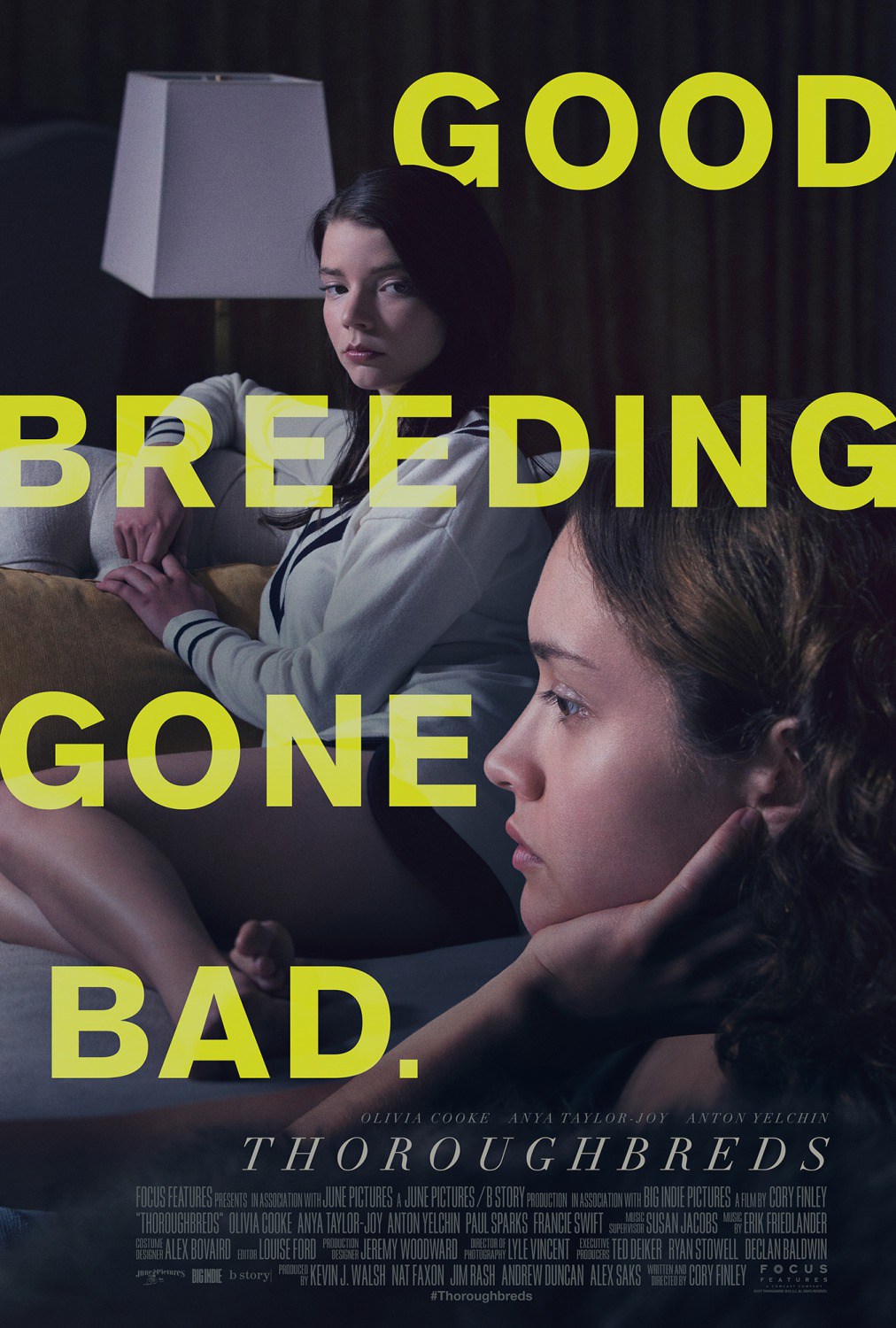
Thoroughbreds

Thoroughbreds revolves around two friends, Lilly,(Anya Taylor-Joy) and Amanda, (Olivia Cooke), as they try and murder Lilly’s stepfather Mark. Both actresses give fantastic performances, with Olivia Cooke, in particular, being a show stopper. Cooke’s lack of emotion is eerily clear and will make you feel uncomfortable; with the film using some wonderfully slow scenes showing her staring off into space, thereby building a feeling of quiet uneasiness. Anya Taylor-Joy’s Lilly is also fantastic as we see that she is also incredibly cold, but rather than let that show she builds false personas. What Thoroughbreds does, in my opinion, better than any other film I’ve seen this year, is build great three dimensional characters, that you can empathize with. That is the genius of this film: even though Lilly and Amanda do terrible things throughout, you still feel sorry for them even in a way you root for them. The film is paced superbly, giving the character there due time, without wasting a single scene. Anton Yelchin plays Tim, a drug dealer the girls originally try and blackmail into doing the hit for them. Yelchin’s performance is genuinely layered, with him being initially quite menacing and threatening, whilst later on, he’s more sympathetic. The use of sound design in this film is incredibly clever, with the sound of the rowing machine, slowly driving Lilly into insanity being very reminiscent of the works of Edgar Allen Poe. I felt quite a lot of Poe’s influence in the film with elements reminding me of both the TellTale heart and the Raven. Furthermore, the use of the violins and cowbells, as non-diegetic parts of the score, was inspired as it has a wonderful off-kilter quality. The ending was genuinely upsetting, which is a testament to how much you end up caring about these fundamentally bad characters. Overall this is a very cold film in the best possible way, being incredibly tense, but also oddly warm at times. This is definitely a must see, but be warned it most certainly isn’t for everyone.
4.5/5
Reviewed by Luke

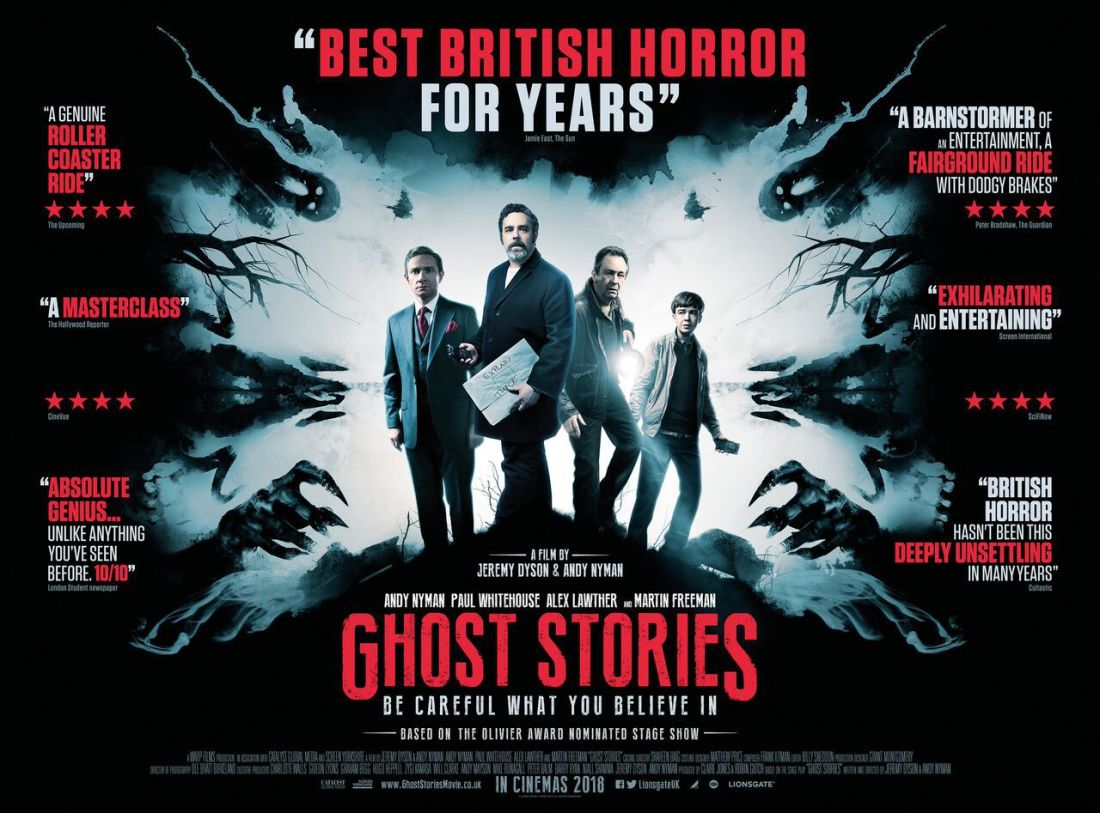
Ghost Stories

Ghost Stories focuses on Professor Phillip Goodman, (Andy Nyman), a sceptic, as he tries to explain 3 of his ideals cases; revolving around different types of supernatural entities. The 3 cases are all very unique, giving each one a strong sense of identity. Nyman’s character of Goodman has a very strong arc, slowly transitioning to a believer the more the film goes on: as he sees things he can’t explain. The ending, which I’ll talk more about later, really helps to develop Goodman’s character; whilst also showing his motivations for trying to disprove what he would deem delusions. The first case revolves around a night watchman as he is pursued by restless spirits, this case is menacing as it prays on a person’s fear of what lurks in the dark. The second case focuses on a hit and run accident, on a deserted country road, whilst that may sound like a cliché horror movie set up, the performance by Alex Lawther truly elevates it. Lawther constant twitching wide-eyed performance really conveys the unhinged nature of his character bringing a great amount of believability to the role. This second case is the most frightening, with 3 truly haunting words of diegetic dialogue; that you will remember long after you’ve heard them. The third case revolves around Martin Freeman’s character of Mike Priddle, as he talks about the poltergeist that plagued his family. This third case is the weakest having by far the least amount of scares. Ghost Stories plays upon natural humans fears: whether that is the dark or isolated places; forcing the viewer to contemplate whether there is more to the world then they choose to believe, making it a very unsettling film. The ending, in one way it is a triumph, as the message of the film is be careful what you believe in, and the ending certainly hits that message home. However, it is also an anti-climax as it seems to throw away all of the atmosphere and the general feeling of uneasiness, that the film has built.
Overall this is a strong British horror and I would definitely recommend it to genre fans.
4/5
Reviewed by Luke

A Quiet Place

Spoilers ahead!

The Quiet Place is a horror film that follows a family as they try and survive; in a world overrun by sound hunting creatures. John Krasinski stars as the father of the family Lee, perfectly capturing the fear of a father who lives in a world where his kids might not grow up. Early plot developments show why this fear is justified and earned, the scene in which his youngest son dies is both heartbreaking and incredibly tense. Said scene is very indicative of what the film is, in essence, an hour an a half of pure tension using jump scares and atmosphere to a masterful degree. Right from the start, The Quiet Place builds tension, layering it, only to release it when you least suspect. The Quiet place is an excellent horror film: for the simple fact that the suspense and atmosphere it creates is, in my opinion, unrivalled by any other horror films of recent memory. Evelyn, (Emily Blunt), Regan, (Millicent Simmonds) and Marcus, (Noah Jupe) all help to sell the tension, as you can see through their performances the toll living in such a world has brought upon them. The shocking death scene, that I have already mentioned, is incredibly well done because it creates a real sense of mortality: emphasising the fear and peril the family go through eliciting a genuine emotional response from you. The screenplay is incredibly tight with each scene in the film feeling needed. However, the plot line of Regan blaming herself for her younger brother’s death is too drawn out. The use of sign language and the sound design is fantastically innovative, really helping to set this apart from other horror films. This is one of the most interesting films I’ve seen in a while, with the mythology and the background behind the events being left up to the audience’s imagination; with only a few tantalising hints being given. The creature design is fantastic, being both unique and terrifying. The focus on ears and sound in this film is very unique, and the fact that the creature design encompasses this theme only heightens it. Finally, the ending is a welcome contrast to the rest of the film, as it offers some hope that the creatures might be able to be defeated; this contrasts nicely with the fairly grim tone of the rest of the film.
A very tense and unique ride.
4/5
Reviewed by Luke

Unsane

Unsane is a psychological thriller film starring Claire Foy as a person who is wrongfully committed to a mental health institution; whilst there she is terrorised by her stalker. Unsane is one of the most menacing films I’ve seen it a while: due in no small part to the real-life nature of the threat. This is because this isn’t a ghost or a ghoul or something mythical, but rather something very human. The initial shock of Foy’s character, (Sawyer Valentini) being by all intensive purposes tricked into voluntary commitment is quite substantial on it own: however, it is the introduction of the stalker into the mix that really raises the threat level. Joshua Leonard’s performance as David, (the stalker) is outstanding: particularly as his obsession with Foy’s Sawyer reals so genuine and real. Unsane is a foray into mental illness at it’s most disturbing, as it easily manages to get under your skin. The script has you at times both rooting for Sawyer and, at times rooting against her: as you are never quite sure whether what is happening is real or in her head. It is this sense of ambiguity that really makes you reflect on the idea of mental illness. This film is directed by Steven Soderbergh; with each shot giving you a further insight into Sawyer’s state of mind. Soderbergh shot this film on an iPhone, which I truly believe is quite a novel thing as it shows a whole new frontier for filmmaking: demonstrating how you don’t need an expensive camera to make a stunning piece of art. Filming Unsane on an iPhone gives it a raw feeling, which truly adds to the believability; making it strike a lot closer to home. The film itself has quite a Hitchcockian tone to it: which on more than one occasion caught my attention. The performances are all very well used with each actor squeezing every bit of life from the script that they can. Juno Temple’s performance as Violet; one of the other patients at the facility along with Sawyer is exquisite as she completely loses her self in the role. At points this film made me quite uncomfortable as it really got under my skin, this is truly the best praise I can give it. Unsane is not like a lot of modern horror/thriller film out there being reliant on quick scares and twists: being instead far more into building atmosphere and tension to a satisfying climax. This is a superb thriller and will really give you something to think about; definitely not for the faint of heart.
4.5/5
Reviewed by Luke

Mom and Dad

Mom and Dad is a horror film focusing on a television signal that turns the parents into murderous monsters. The film is a study about growing old and accepting change. However, this character study is conducted with the nuance of an atom bomb. This lack of nuance isn’t a detriment because this film is wonderfully tongue in cheek throughout, it revels in the sheer insanity of the plot. The plot is ridiculous from the get-go with a scene in the first act about a group of parents climbing over the walls of a school to kill their children. The slow-motion editing that follows this scene is very well used, really adding to the graphic nature of the scene. Continuing on, the film is paced very well with every second of screen time being used to full effect. The characters are quite two dimensional overall with only a few scenes and flashbacks serving to develop them outside the craziness. Nicolas Cage is in top form as Brent, with each manic action his character performs being elevated by the insanity in his eyes. This film features a performance by Cage at his most manic, and if that is what you’re into then this film has you covered. Selma Blair is similarly fantastic with her matching Cage’s insanity in every scene. Blair’s character of Kendall probably has some of the best emotional beats of the film, showing what it’s like for a mother having to let their child go. In this way I found myself feeling quite sorry for her for the first act of the film. However, the main issues of the film come from the performances of the children. To preface my complaint let me first say that the children are the protagonists and the parents are the antagonists, as such, I shouldn’t have been rooting for the parents. In that lies the problem the children just aren’t likeable. Annie Winter’s character of Carly is incredibly annoying throughout the first 30 minutes of the film and, is seemingly written as all the worst stereotypes about teenage girls rolled into one. Furthermore, Zachary Arthur’s character of Josh is just dull never really adding much to proceedings and feels like he’s just there for the sake of it. I don’t think that these are the faults of the actors but, rather the faults of the script. The script is good in a lot of ways which helps to boost the crazy on-screen visuals, but at the end of the day, it’s more spectacle than anything else.
Overall, I would highly recommend even if some of the performances are bad.
3.5/5
reviewed by Luke.

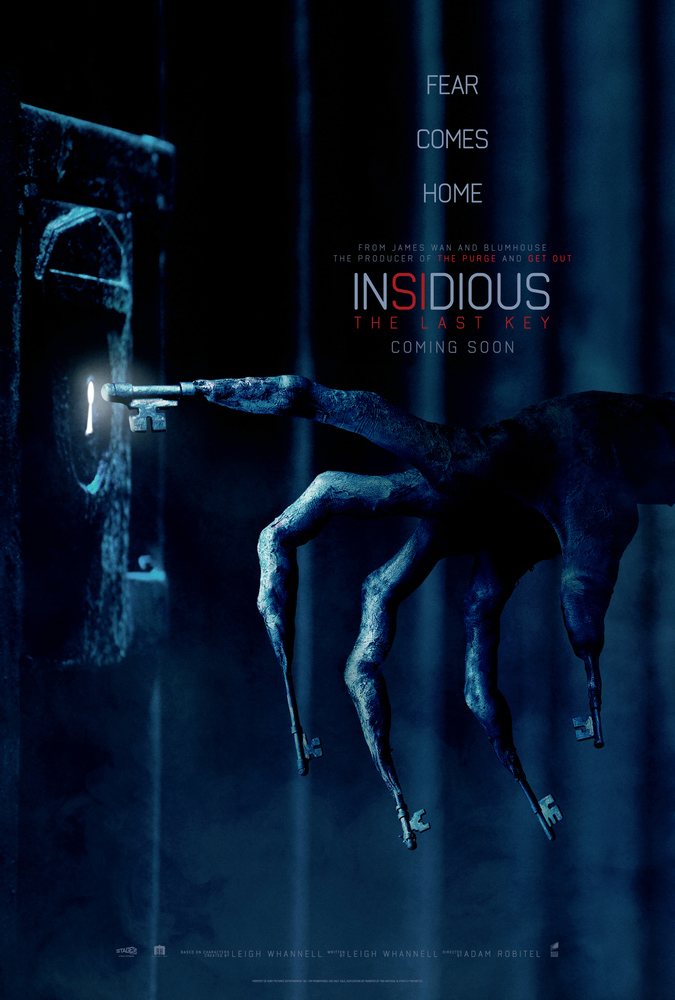
Insidious: The Last Key

This supernatural horror film is the sequel to Insidious 3, and a prequel to Insidious 1 and 2. This instalment works as somewhat of a close loop for the series, bringing  everything together.  The Last Key, serves to add context to the childhood of  series regular Elise, (played by Lin Shaye in the only truly well acted performance in the whole film), and it is in this backstory that the film shines. Without giving too much away these flashbacks serve to highlight Elise’s gifts, as well as her past history with the Further and demons. The new entity for this instalment is Key Face, who is  quite an interestingly designed creature, a far cry from the woeful, Man who can’t breath, in part 3 who wasn’t scary in any way. Furthermore, during scenes involving Key Face something quite interesting is done with the films sound design, as the victims are screaming Key Face will insert one of his key shaped fingers into their throat, immediately making their screams silent no matter how long they carry on for. Sadly that’s where the positives end for this film, and it is with a heavy heart I write this, because I really liked and enjoyed the first two Insidious Movies, but I feel like each entry since then has got worse and worse; with this entry being the testament to that decline. First off other than Elise and I guess her father ,(played by Josh Stewart), no one is really given any development, or a noticeable arc. Tucker and Spec’s ,(Angus Sampson and Leigh Whannell), are used wholly for comic relief, and its the humour in this film that is it’s greatest detriment. The humour never and I mean not once lands, the humour ranges from cringe bad to straight up unfunny. The only time people in my screening were laughing was during the jump scares and moments that were suppose to be scary. That’s another failing of this instalment, there just aren’t that many jump scares, which isn’t always a bad thing in terms of horror as tension and atmosphere are just as important, but overall this film isn’t scary in anyway. The only true scares come from the domestic violence in much the same way as Sinister 2, rather than the supernatural threat. Insidious The Last Key, is the truest definition of the bad movies that plague January, with its whole existence feeling like just a way to extend the franchise. What’s more is the introduction of Elise niece,(played by Caitlin Gerard), who has the same gift as her, also she  doesn’t have a huge role except being Spec’s love interested, but to make matters worse here introduction is a clear way for them to make Insidious 5 now that Elise’s story has run it’s course.  In many ways this film was a waste of resources and peoples time, providing at best one good performance, some interesting design choices and perhaps one solitary jump scare; that actually works. To sum up whilst it isn’t terrible it’s a clear example of a franchise that needs to end.

2/5

Reviewed by Luke