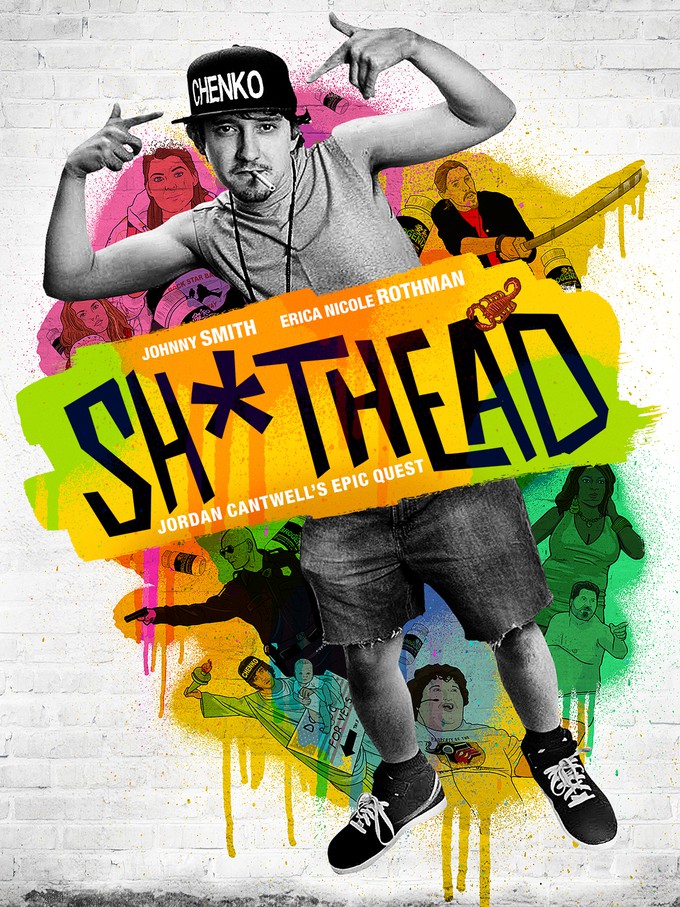
Interview with Mike Morelli: Writer/ Director of Sh*t Head

Written by Luke Barnes

Hey Everyone! I recently had the chance to interview Mike Morelli, about this award winning feature film Sh*thead, which is about a man selling his friends baby, so that he can afford to go and see his favourite musical artist. We talk about, wild quests, dancing, and the death of cinema- I hope you enjoy.

Q: If you were to sum the film up in one word what would it be?

A: Stoned.

Q: Do you have any funny production stories?

A: We rented a drone for the concert scene but there was some mix up with the rental house, it came in after we were supposed to shoot with it, so they just let me have it for a full week. We ended up improvising and playing around with that thing literally non-stop the whole week, just trying to get whatever wide-shots I could with it. I had Jordan’s costume and from far enough away, if I put it on you really couldn’t tell as easily Jordan suddenly got like 6 inches taller. I did a ton of those shots, and most of the actors weren’t available on short notice so a lot of times I’d program a route for the drone, run into place and try and get the shot all by myself. It always felt like some bizarre silent film routine. 

At the end of the week, I had literally done as many shots as I could possibly think of they were coming out so good, I had one night left with the drone, I was just like, alright, you know what if we get really far away and it’s kind of dark, maybe I could pull off doubling as Janeé too? I had Erica’s costume and a wig, so, yeah I put it on, stuffed some balloons in my chest and set out at 4AM to try and sneak some night shots where no one could see me. 

I did like four or five shots, and it really wasn’t working no matter how far away you got you just could tell – that’s no lady. There was no way anyone was gonna’ buy that was Janeé. Ever. 

To do the shot, I’d have to program the drone, run into place and then I’d have 30 seconds before it starts. And I remember, I’m right in the middle of doing one of my last takes and this van full of young, construction guys probably going off to a super early morning job pulls down the road before I had time to hide. And they just stop. And stare at me. And they see this crazy man, dressed as a lady with balloons in his chest, flying a drone. At 4AM. Filming himself. 

They didn’t laugh, they simply stared at me for like a full minute trying to piece together what the hell their eyes were seeing. The looks on their faces, thinking about now I’m dead. 

None of the shots made it into the film. 

Q: What inspired you to make this film, what was your drive, your catalyst?

A: I made a short called “SHITHEAD” that this is loosely based off. I sold weed when I was younger, and I was always fascinated by the delicate juggling act that went into balancing out a serious illegal drug habit. Drugs aren’t free and by the very nature of the activity, they need to be replaced fairly often. So, it becomes this game of constantly trying to make money, find drugs, take the drugs, run out of drugs, repeat. 

Now take that dynamic and tell it like a raunchy, Preston Sturges screwball comedy. That was the idea, at least. 

Q: Does your film have a message and if so what is it?

A: Don’t sell your baby. Use Birth Control. Liberate Taiwan. 

Q: Who is your filmmaking influence?

A: My older brother, John. Authors like Charles Willeford and James Ellroy loom large in the stories I like to tell. There are so many filmmakers from around the world I could name drop to make me sound smart, but I’ll stick with that. 

Q: How would you describe the film’s sense of humour?

A: Juggalo Crack. I guess that’s really what Chenko is, anyway. 

 Q: Have you ever been on any wild quests of your own?

A: Making this movie. Without a doubt the most epic quest that I have ever been on. And I’m still talking about it, right now…

 Q: If you had the sum the production up in a word what would it be?

A: Vietnam. 

 Q: If you could travel back in time to when you were a young filmmaker just starting out what advice would you give yourself?

A: Learn to dance. I’d tell myself that, hey, by the time you’re able to release your first feature film cinema as you know it, conceptually, will be dead. Monopolistic corporations will destroy a lot of the things you hold so dear, and people’s attention spans are going to dwindle to below a minute. Maybe less.. So learn to dance and Tik Tok. It’s your best shot. 

 Q: If you ever win an award who will you thank in your acceptance speech?

A: I probably wouldn’t attend any awards ceremony. I actually just won something and am trying to get someone to attend virtually in my place. Nobody knows what I look like, it would make me laugh so hard if they cut to a speech by me and it’s like a 90-year-old man from Wisconsin or something. 

We did win some awards for Sh*thead, I never attended any of those ceremonies to thank anyone. 

That’s not because I’m not grateful, far from it. Making an Independent Film is tough, and you need a lot of passionate, motivated people for it to work. And we had a lot of talented souls come together to make Sh*thead. I really am deeply thankful for so many people. Of course, I gotta’ thank Johnny Smith who is a genuinely great person and good friend of mine. Johnny lit up our film, everyone on set loved being around him so much. And people don’t realize, Johnny had severe back issues from a car accident, he was in a lot of pain during the shoots. And Tom Valentino and Erica Everett, I gotta’ thank them so much, they stuck with the film, and me, to see this through. I’m grateful to everyone that helped make Sh*thead happen, thank you all. 

You can watch Sh*thead on Amazon Prime, Google Play and Vimeo and as always my review of the film is up on site right now!

Interview With McCain Lindquist Director Of The Tell Tale Heart

Written by Luke Barnes

Hey Everyone! I recently had the chance to sit down and chat with The Tell Tale Heart director McClain Lindquist, and we chatted all things horror- Poe, Hitchcock and of course the horror films of the 1970s and the 1980s. Be sure to check out my review before reading this, for further context- it is on the site now. I hope you enjoy!

Q: How important were practical effects to you with the Tell Tale Heart?

A: Practical effects were critical to our film. Using tangible special effect makeup was a decision we made right from the beginning. Our love of 1980s horror/Sci-Fi would be the impetus for this nostalgic approach. Respect for the modern masters would be the driving force in their inclusion. The late 70s and early 80s were the high-water mark of practical special effects and influenced us immensely. We harkened to the heady days of amazing films like American Werewolf, The Fly, Alien, The Thing, Howling, Evil Dead 2, and The Blob to achieve a realistic yet surreal tone. Chris Hanson tasked with the special effects department is a wizard and we were blessed to have his expertise and creativity involved from the earliest stages of preproduction.

Q: What is your favourite horror film and who are you influences?

A: I have such a long list! It’s so hard to narrow down to one film. But here are a few… The Exorcist, The Shining, The Omen, Rosemary’s Baby, Psycho, Deep Red, The Beyond, Shock, Hellraiser, Texas Chainsaw, Halloween, Train to Busan, Night of the Living Dead, Jaws, REC, Descent, Funny Games, Carnival of Souls, The Skin I Live In, Cape Fear, Devils Backbone, Jacobs Ladder, Poltergeist, Babadook, The Ring, Let The Right One In, Carrie, Suspiria, The Others, 28 Days, Dead Alive, but if you had to pin me down and say one movie it’s… Evil Dead 2!

 Q: Sequel ideas?

A: I have already parlayed or rewritten the (sequel) full length version into two distinct screenplays. I have no interest in doing a follow up film for The Tell Tale Heart. So I pilfered my own ideas and applied unused aspects from my original script to the new stories. Both of the scripts are also based on Edgar Allan Poe short stories. The Cask of Amontillado and The Black Cat. This trilogy of short films (including Tell Tale) would work splendidly within a movie anthology of Poe shorts. My full-length film fit perfectly amongst those two intense stories. So I just transplanted settings and characters to fit the narrative. It worked surprisingly well and came together very quickly and easily.

 Q: How did you get into filmmaking?

A: I was tasked to write, direct and produce the music videos for my band Bass Mint Pros. We shot our first music video in beautiful Death Valley National Park. I took to the entire process of filmmaking very quickly and shortly thereafter I was shooting local commercials, musical/political spoofs and then web based serials. Being a cinephile and film buff, making a movie was the next logical progression.

 Q: What are your thoughts on modern horror?

A: I have a deep love for the genre of horror. My favorite horror movies are the Universal Monster classics. As time passes sadly even the amazing genre films I grew up on are now considered outdated and vintage. Like all art forms it must change and grow, or it becomes stagnant and then dies. In my opinion modern horror is incredible. It’s the next logical step. I find this new wave of heady horror hounds to be most invigorating. It’s really refreshing to see the next batch of filmmakers having a sense of cinema and apply elements of art house to their films. Watching new perspectives has been eye opening. I want to see films from all cultures that represent a new and yet unseen viewpoint. I am also pleased with the style and bold experimentation in their vibrant films. I love the depth and emotional power of these trailblazers. Elevating the art form could never be (and should never be) seen as a negative element when it comes to the evolution of scary films around the world.

 Q:  Which do you value more when making a horror film, scares or atmosphere?

A: Atmosphere without a doubt! Ninety percent of horror is generated through atmospheric dread. The vast majority of atmosphere in cinema is created by gaffe or lighting. Pace, setting and tone are all vital to instil a spooky ambiance as well. As strange as it seems being “scared” is not critical. Everyone has different responses to fright. However I personally love jump scares and want the audience of my films to most definitely feel fear and become afraid. Fear is such a fascinating response to me. Fight or flight can be achieved without cheap scares if you carefully take the time to build up to the intense moments. Let the audience create the ambiance within themselves. It’s a litmus test of sorts. Don’t undercut the imagination and creativity of the viewer. They might just surprise you!

 Q: Do you have any fun production stories?

A: Too many to count! Fun is the perfect word to encapsulate our production. If you aren’t having fun why even create art? We have three rules to our film productions. 1. BE SAFE! (No one should EVER get hurt making a movie) 2. Work hard! (Duh!) and 3. Have FUN! It’s hard to think of any element that wasn’t incredibly fun while making this movie. It was very upbeat and jovial on set. Lots of light-hearted inside jokes abound. I was usually the butt of everybody’s joke and was pranked endlessly each and every day on set. I got them all back, however. When we watched the trailer at the wrap party I purposely had the file slow down and go into buffering mode. It was hilarious to watch them all squirm. Revenge is dish best served… COLD!

Q: If you were to describe the production in one word what would it be?

A: Definitive

Q: If you could meet and chat to any living or dead filmmaker who would it be?

A: Living – Martin Scorsese / Deceased – Alfred Hitchcock.

Q: If you won an Oscar who would you thank?

A: I would have the shortest speech in the history of the Oscars and beat Joe Pesci by one word. I would simply say… “Thanks!” However… I dedicated this film to my two beautiful daughters. I love them more than words could ever express, and they would be first and foremost on my mind.

Q: How important was Edgar Allan Poe’s influence over the film as a whole?

A: Edgar Allan Poe’s immense influence permeated throughout the entire process of the making of this film. From my brother nailing his voice in the dialogue to Janelle Corey’s costume design which we used Poe as the model. All the way down to Nikki BreedLove’s hair style which was styled in the vein of Edgar. Hell even Lyndi Bone’s set design was also inspired by the venerable Mr Poe. We wanted to respect him and his vast influence completely in our short film. This is his story. We are just tourists merely visiting his macabre world. I hope he would approve and appreciate our deference to his lasting legacy.

If you are interested, you can check out The Tell Tale Heart on the festival circuit right now! Or own in on VHS tape by ordering it from Telltalemovie.com

Interview With Craig Everett Earl Writer/Producer Of Intrusion: Disconnected

I recently had the chance to interview Craig Everett Earl, the writer and producer of horror film Intrusion: Disconnected, you can find a review of the film on site now, we chatted about everything from the state of modern horror, the trials and tribulations of filmmaking and of course the topic every interview needs, ICarly. Enjoy.

Q:  Important is creating and maintaining a running sense of tension to you in your films?

A:  I used to think that it wasn’t that important. Back when I wrote and produced the first Intrusion, I really didn’t want to concentrate on that. I just wanted to make a good story and characters people cared about. There is a big audience that considers a movie not being scary if they haven’t jumped, but basically the jump scare films are typically a loud cue in the music, the camera switching from a wide shot to close up and back to a wide suddenly with that loud cue. I’ve always thought realism in horror films was more scary because it’s unnerving when it’s something you can relate to or hear about in the paper the next morning. However, I gotta say tension and suspense definitely enhances the experience. With Intrusion: Disconnected, I tried to throw in a couple of jump scares but tried to focus more on the characters and try to get people relating to them. I think connecting to those characters and not wanting them to die is scarier in a sense and creates tension all on its own. The acting and the score for a film really enhances that tension and then in post you can always throw in the jump scare stuff for fun.

Q: Do you have any goof on set stories?

A: We have this running joke on set. One of my cinematographers brought up iCarly to get a point across for some reason. I honestly don’t even remember why. Somehow though, it turned into this ridiculous and meaningless joke. A couple of the cast started bringing up and blaming iCarly for everything whenever we had an issue. At one point, I believe one of my crew snuck a movie into the shot that actually said iCarly on it as a reminder. We had a blast running the gag into the ground. People would drop it and then someone would bring it up again to keep it going and everyone would sigh and laugh.

Q: Who is your inspiration artistically?

A: I was actually inspired by A Nightmare on Elm Street at age seven. I’m really disappointed I never got to meet Wes Craven, but I remember wanting to watch it and my mom telling my dad that I better not have nightmares. I wasn’t intrigued with the gore and killing, but the practical effects and I really loved the character-driven nature of it. Nancy Thompson was this character you were rooting for in every scene and one of the reasons I love horror. I also remember my parents having friends over later and telling me to go play with their kid. The first thing I showed them was A Nightmare on Elm Street and I think it terrified them. My parents said it was fine if it didn’t scare me but stop showing it to other kids. I’ve since met Robert England and Heather Langenkamp and they’re terrific people. John Saxon read the script and loved it but couldn’t sign on due to some SAG conflicts. Besides that though, I actually turned hugely to Poltergeist when I wrote Intrusion: Disconnected. I love how you think the film is over and there’s an entire thirty-minutes of chaos. I looked to that film when writing the script. I didn’t want anyone to know how or when it would end. I’ve seen so many horror films, so I really tried to make the audience think they knew where it was going and do the opposite.

Q: How would you describe the production in a word?

A: Exhausting. As a producer it definitely takes a toll on you both financially and emotionally. It’s very stressful and even if you’re prepared for things like the weather, sick actors, props not working properly, locations falling through at the last second, or even blocking and lighting a scene; it’s all something you have to be prepared to make quick, last second decisions to fix. I’ve lost thousands on a couple of days because of things that are beyond anyone’s control. Also, people on websites are so quick to condemn a film just after seeing a trailer, or the first five minutes. Someone writes the script, but then you have it go into production and the studio or director might decide to change scenes or things could get cut in the editing room. You hope you have good actors, audio, lighting, sound, the right score and a good editor. Any of these things could completely ruin a film. We had a lot of issues on the first Intrusion and it was basically like film school and a learning experience. So much got changed it took me six months to decide if I even liked it. After finally having our first screening and huge applause I calmed down a bit and enjoyed the film, despite the flaws. For Intrusion: Disconnected, I got about ninety-five percent of what I wanted and my director, Kyle Cates, and I was on the same page most of the time. That and having the tremendous cast and crew I did.

Q:  If you could go back in time to when you were an early filmmaker just starting out what advice would you give yourself?

A: Even if you’re just starting out and prepping to make a project start marketing yourself and growing a fan base. I’m still kicking myself for that to this day because I hate spending hours on social media and promoting constantly but that’s a big part of it. When I first started out I couldn’t get anyone to look at anything or give me the time of day. I had written a couple short stories and a novel and wasn’t really getting anywhere with them. I wrote Intrusion and went and got a loan. I ended up having to get two loans before I was able to shoot it. I hired a crew, found a cast and years later we’re getting rave reviews on this one and I’ve now written two features, produced three and worked on other projects, including one for Brad Pitt. Everything is a learning experience and networking. Once you start bumping into the same people at festivals they start to see your persistence and drive. That’s when they eventually want to work with you. People don’t become successful overnight and if you’ve actually made something that is a success, who if not everyone loves it. Somebody will always hate it. Making a film is without a doubt the hardest thing I’ve ever done. I completely respect everyone’s opinions, but most of the time when I see the really crude comments, I’m actually thinking they should go try to make a film themselves. It’s harder than they think. Even if I don’t like a film, my hat is off to those people for finishing it.

Q: What is more important to you as a filmmaker an overall atmosphere, or a series of individualized moments?

A: I basically treat my scripts like book chapters. I typically start by having an opening and know how the film is going to end. I think an ending is the most important part and with a lot of films I really feel let-down by the third act and the ending. I also think it’s hard to get it just right. I think atmosphere is extremely important as well, but a lot of films have great atmospheres and not enough intrigue to keep the story interesting. I also think there are times where you’re pushing for time on set with budget restraints and not everything works out. Some of that can be fixed and made into a better atmosphere during the editing process by leaving stuff on the cutting room floor and a great score to raise the tension. Sometimes, the best things happen during editing just experimenting and trying different things. I owe a lot of the atmosphere in this one to performances and the score that David Obaniyi composed. I thought he did an amazing job.

Q:  When having a killer or villain who is a constant threat, how do you think is the best way to communicate that to the audience?

 A: With the first Intrusion I really went for the normal guy next door. I originally was thinking about big and intimidating, but that’s been done to death. My wife and a friend actually said how serial killers don’t look like horror villains. They’re tall, skinny and look like the guy next door. I thought that was a lot more interesting to show this realistic version of a man and how he becomes a killer. With the sequel, it’s all about that grey line between good and evil. You have a heroine, Holly Jensen, played by Katie Stewart who is suffering from PTSD and mentally broken from the beginning of the film and the killer, Raymond Hummel, played by Lee Haycraft, now realizing his true nature and having this God-like complex. He’s much more calculated and manipulative in his actions. I think it’s scary that given the right circumstances something can send someone into madness and down that dark path. I wanted to tap into that more, along with some similarities between Holly and Raymond as people. In the original Intrusion, Raymond found out his girlfriend was cheating on him and killed her. Holly comes home and thinks that her boyfriend Peter is cheating for a moment. I did that on purpose. They’re both people with the circumstances they’re dealing with. The question is when given that hand, which path does the person take. I think that’s a lot more disturbing, the films that stick with you afterward and keep you thinking about things that make you uncomfortable. We all have this dark side. Most of us choose to be good people. The people that do not are definitely a threat.

Q: Future plans and sequel ideas?

A: Right now I’m actually in the process of revitalizing the book that I wrote years ago. It’s this love story that actually starts with tragedy in a small town with four characters surrounded by a lot of different dark issues in their lives. Not sure if it’s going to be a re-release since I own the rights again, or a possible film, but it’s something I’ll eventually put out there. I would love to do more projects with my cast and crew. They’re all extremely talented, but that’s going to depend on the success of Intrusion: Disconnected. I spent 25K on the first Intrusion and 80K on this one. I can’t do that again. If I get financing or funding for it I would love to keep doing this. I would love to do a creature-feature with Katie and Lee. Could be a lot of fun, but I love the drama genre. I definitely want to do something in that realm before going back into horror again. I have no plans to do a third Intrusion film but if a studio wanted to more with that world, I have a pitch for a T.V. Show that could be fun, but I doubt that will happen. I only did a sequel to Intrusion because we used it as a springboard for a more interesting, fresh idea. I think that’s the problem with sequels. If they’re made, they need some time to breathe and a better idea.

Q: How would you describe the state of modern horror?

A: I think the state of modern horror is great. It’s definitely thriving again both in a nostalgic way and with a lot of original films. A few years ago slashers started to disappear, and it was leaning more toward found footage and then a lot of paranormal films. Now, you seem to pretty much have your pick, and slashers are definitely on the rise again. Some people hate combining comedy with horror, but I think we have enough films coming out it’s great that everyone is trying to do something fresh with them. I just recently saw Spontaneous and thought it was brilliant. It was a love story about kids suddenly exploding, mixed with sci-fi, drama, horror and comedy and it worked perfectly. I think balancing different genres can be tricky and don’t always work, but I also think that it’s great people could make something and put any spin on it they want.

Q: If you ever won an Oscar who would you thank in your acceptance speech?

A: I would definitely thank my cast and crew. Without them, especially with this film, it wouldn’t have been possible. A couple of them went out of their way to make sure this was a reality. More than anyone though, I would thank my wife. I try hard not to bring my stress home with me when making a film, but that’s nearly impossible. She has been there from the beginning with me and picked me up a few times. I’ve also put her through Hell sometimes and things I still have a hard time forgiving myself for. We talked about having kids years ago and I put my career first and she gave up a lot of her dreams to let me achieve this and to let people see this. I had one day when I was on set out of state and she lost her mom. I had just seen her mom and they gave her about six months to live. My wife supported me to shoot the film because we were already prepped for it and everyone had cleared their schedules. During the shoot, got the phone call that she was going to pass away early after only weeks after we found out. I focused and was able to get through the shoot, but we took a break after that because I wasn’t there emotionally and even though my wife didn’t blame me it’s something I really hate myself for. I know her mom was asking for me minutes before she passed. That alone is heart-breaking and one of the many sacrifices I’ve made for people to be able to see this. Even when you achieve success it’s never this perfect way you imagine it. It comes with demons.

I hope you have enjoyed this interview, be sure to check out Intrusion: Disconnected now on Amazon Video and be sure to join me again for other interviews, features and reviews.

Luke  

Interview With James Watts (Death Trip)

Hey guys, just a bit of a lead in before the main event. This is my first interview and my first foray into that side of being a film reviewer! I recently had the chance to ask the director of Death Trip James Watts a few questions, about filmmaking, horror, and what it means to make a slasher film in the 2020s. Here is the interview verbatim.

Q: Who is your biggest inspiration?

 A: The films I am the biggest fan of have all managed to incorporate comedy (in one way or another) into their respective genres. Mary Harron’s American Psycho is a perfect example of this. There is nothing funnier to me than the scene in that movie where Patrick Bateman has peak-level stress over Paul Allen’s business cards. 

Alfred Hitchcock is obviously the best at this but so are the Coen Brothers, Robert Altman and Lina Wertmüller. 

And of course, the argument I always get into with friends is whether or not all of Stanley Kubrick’s movies are secretly comedies (I think that they are).

Q: What is your earliest memory of the horror genre?

A: Like a lot of people my age, my first experience with the horror genre was seeing excerpts from The Shining in the background during a memorable scene in the “Helen Hunt banger” Twister.

Bill Paxton is hightailing it to the weather van, the tornado is in full effect, but all I could focus on was the psycho with the axe being projected on the drive-in screen in the background. 

I was scared to watch The Shining for years because of that movie.

Q: How would you define the modern slasher film?

A: I feel like the slasher genre will always be modern. As far as I’m concerned, as long as there are a group of victims, a mysterious stalker and violence – anything goes. It’s really all about what the filmmakers do with those elements. 

Vera Dika has a good book about 70s and 80s slashers called Games of Terror and in it, she describes the appeal of the slasher movie: “catharsis”, “recreation” and “displacement”. That statement was about the 80s specifically, but modern slasher films are still appealing to audiences for these same reasons…and critics still hate them.

Q: Do you have any funny on-set stories?

A: Garrett jumped in the lake.

A freezing cold lake. 

We drilled a hole in it and he got in. In the movie, there’s never a clear angle of this actually happening, but I want it to be on record that Garrett Johnson went into a frozen lake, of his own volition, for the sake of this dumb movie.

Q: What was the message behind this film? And What does that message mean to you?

A: I’m going to repeat verbatim what my co-writer, Kelly Kay Hurcomb says (and she’s the real genius behind this movie): Over the course of the last decade, it has become more and more evident that women’s worst enemies are often hiding right under their noses.

Without giving too much away, the movie’s really about the rising trend of performative ‘feminist allyship’ amongst male millennials and how that has spawned a new brand of ‘wolves in sheep’s clothing’. 

It’s also about how class informs our fears. It’s like if you went to the country and there was an old man living in a cabin next door and you just kind of saw a glimpse or two of him, then later you went to a party with a bunch of “sensitive seeming dudes”…who do you really think is going to kill you? Who’s the actual threat? The old guy is probably just stressing about his retirement fund or how the city’s new zoning laws are going to take away his business.

Q: If you had to describe the production in a word what would it be?

A: Cold!

Q: What is your favourite horror film?

This is, like, the hardest question I’ve ever been asked, so I’ll give some qualifiers:

Christmas Evil is my favourite Holiday horror

The Brood is my favourite Canadian Horror

The Blair Witch Project is my favourite found footage horror

Nosferatu the Vampyre is my favourite horror remake

The Texas Chainsaw Massacre 2 is my favourite horror sequel

Possession has my favourite scene in a horror film

The Mist has my favourite ending

The Descent scared me the most

Ms. 45 has my favourite premise

Angst has my favourite structure 

But if I’m being really honest with myself, I’ve seen The Shining more times than I can count so, by that metric, it wins.

You can watch Death Trip On-Demand right now!

I hope you enjoyed this interview

Luke